Phrasal Verbs with Call for Kids
A phrasal verb combines a verb with a particle, such as back or off, to create a new meaning. Phrasal Verbs with “Call” for Kids: A Practical Guide covers forms such as call back, call off, and call for. Children need to see the action, object, and particle in context. This guide provides rules, examples, errors, and brief exercises for home practice.
What Children Need to Understand
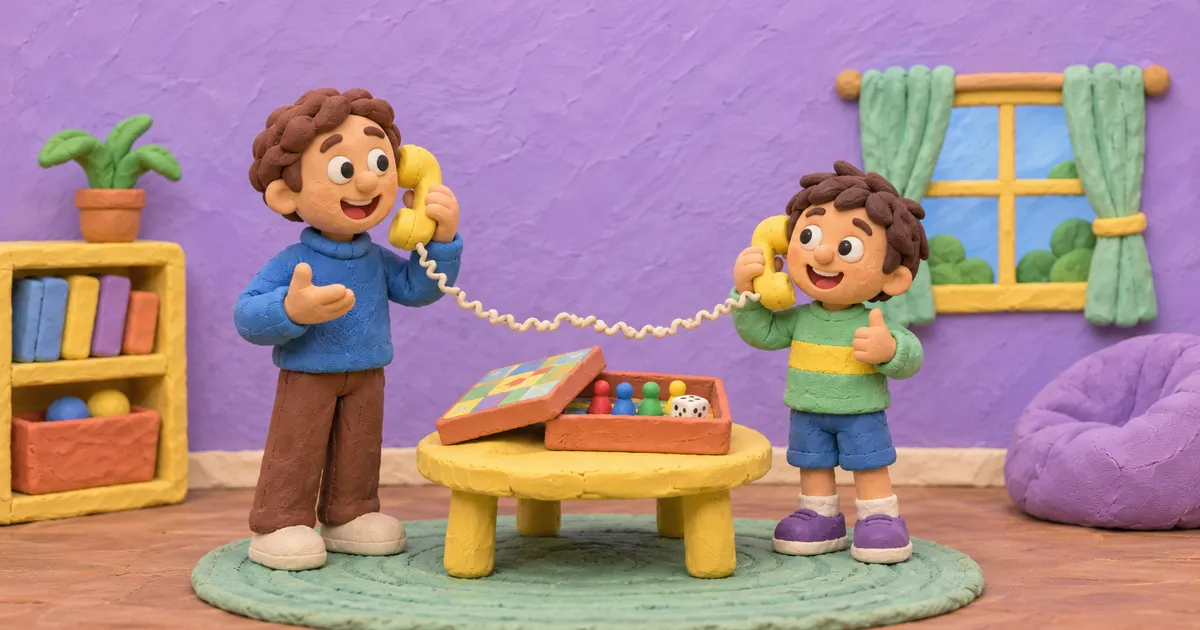
The verb call can mean to speak loudly, name someone, or phone someone. A particle changes the message. “I will call Mum” means the child will phone her. “I will call Mum back” means Mum called first and the child will return her call.
Use Phrasal Verbs with “Call” for Kids: A Practical Guide as a meaning guide, not a spelling list. Teach each expression as one unit. A cancelled-match drawing supports call off; a toy phone supports call back. Children aged five to nine remember actions and situations before formal grammar labels.
How the Particle Changes the Meaning
Particles carry much of the meaning. Back suggests return, so call back means to return a phone call. Off suggests cancellation, while for can show a need. Interpret the whole expression, not each word alone.
Two useful corrections
Myth: Children can always work out a phrasal verb by translating each word separately.
Fact: The particle changes the meaning, so children need the whole expression in context.
Myth: Every phrasal verb with call follows the same word order.
Fact: Some allow two object positions; others keep the verb and particle together.
Context prevents confusion. “The picnic was called off” refers to cancellation, not shouting. Phrasal Verbs with “Call” for Kids: A Practical Guide pairs each form with a situation that connects grammar to a message children may express.
Useful Forms and Everyday Examples
Start with forms children may hear at home, in stories, games, or lessons. The table compares their meanings and object positions.
Expressions can gain extra meanings. Call out can mean to challenge harmful behaviour, while call up can mean to bring a memory to mind in advanced texts. Younger children should learn the phone meaning first, then add meanings encountered in context.
Word Order, Tense, and Pronouns
Some phrasal verbs are separable. With a noun, both “call off the game” and “call the game off” are correct. Pronouns go in the middle: “call it off,” not “call off it.” The rule applies to “call her back” and “call him up.”
A quick pronoun check
Replace the object with it, him, her, or them. With a separable phrasal verb, place the pronoun before the particle: “Call them back.”
Other forms stay together: “call on your friend” and “call for help,” not “call your friend on” or “call help for.” Tense changes call, not the particle: “called back,” “is calling back,” and “will call back.” In Phrasal Verbs with “Call” for Kids: A Practical Guide, track the tense and object position together.
Common Mistakes and How to Correct Them
Literal translation causes errors for multilingual children. Another language may use one verb or place pronouns differently. Give a complete model, such as “The lesson was called off,” then change one detail: “The match was called off.”
Four mistakes to spot
- Wrong pronoun position Change “call back her” to “call her back.”
- Missing particle Add off when the intended meaning is cancel.
- Wrong tense Change “call off yesterday” to “called off yesterday.”
- Mixed meaning Use call for when something is needed, not cancelled.
Children may overuse a new form. “The tutor called on me” means the tutor asked the child to respond; “The tutor called me” means a phone call. Contrast the meanings, then ask the child to match each sentence to a picture or scene.
Practice Activities at Home or in Lessons
Phrasal Verbs with “Call” for Kids: A Practical Guide moves from meaning selection to complete sentences. Read each item aloud for children developing reading confidence. Older children can explain each particle choice.
Choose the Correct Particle
Complete each sentence with back, off, on, or for.
1. The school called ___ the outdoor game because of heavy rain.
2. This activity calls ___ coloured pencils and paper.
3. Please call me ___ after your music lesson.
4. The tutor called ___ your child to answer.
Answers: 1. off; 2. for; 3. back; 4. on.
Then practise object position. Replace each bold noun with a pronoun and say the corrected sentence aloud.
Replace the Object with a Pronoun
1. Please call your grandparents back. → Please call ___ back.
2. They called the match off. → They called ___ off.
3. We called the doctor in. → We called ___ in.
4. She called her brother up. → She called ___ up.
Answers: 1. them; 2. it; 3. her or him; 4. him.
Finish with a thirty-second role-play: a cancelled sports day, a friend’s message, or a recipe requiring three apples. The child chooses call off, call back, or call for, makes a sentence, then changes its tense.
For the rule wording, Wikipedia — English Grammar is a useful reference while the practice examples here stay adapted for children.
Frequently Asked Questions
How Many Phrasal Verbs with “Call” Should My Child Learn at Once?
Begin with three: call back, call off, and call for. Their distinct meanings suit pictures and short scenes. Add another expression after your child understands the first three in context and uses each in a sentence. A small active set beats a long temporary list.
Does My Child Need to Know the Term “Phrasal Verb”?
The label helps older children, but younger learners can start with meaning. A child can act out returning a call, cancelling a game, or asking for help without defining the term. Phrasal Verbs with “Call” for Kids: A Practical Guide teaches the message first, then the pattern.
How Can I Help a Multilingual Child Avoid Translating Word by Word?
Present a picture, action, or situation before individual words. Ask, “Was the game cancelled or started?” then model “They called off the game.” Comparisons with another language can help, but finish with a complete English sentence to link the situation directly to the phrasal verb.
How Will I Know That My Child Can Use These Phrasal Verbs?
Test a new context. Your child should choose the correct expression, position a pronoun, and change the tense. Ask for sentences about a cancelled party, a returned phone call, and a recipe needing milk. Independent choices show stronger understanding than immediate repetition.
A short one-to-one lesson can show what level and pace fit your child — book a trial English lesson.
Stay updated on our latest tips and resources by following us on Instagram LearnLink.